Technical preview
Kova
A modular, general-purpose game engine foundation written in Rust.
Kova explores a library-first engine architecture with public 2D and 3D authoring APIs, explicit plugin and backend boundaries, and validation through real runnable examples.
The engine is under active private development. Its current milestone proves the core public application, scene, rendering, input, and transform paths without requiring game code to manage WGPU, winit, or the renderer lifecycle directly.
Public engine APIs are exercised through real desktop examples rather than architecture documents alone.
Ordinary example code does not manage WGPU resources, winit events, or manual render lifecycle stages.
Visual examples are paired with deterministic or backend-free smoke paths where practical.
The private repository is being prepared for an explicitly unstable public-source pre-alpha release.
Overview
What Kova is
Kova is a general-purpose engine foundation rather than a game-specific framework or renderer experiment.
Its public surface is being designed so that an external project can construct an application, compose plugins, author scenes, create assets, respond to input, and run through a normal desktop path without reaching into backend implementation details.
The current codebase includes engine foundation, ECS and application layers, public scene and transform authoring, 2D and 3D rendering paths, input and camera APIs, assets, materials, meshes, diagnostics, desktop runtime composition, and optional voxel extension work.
Kova remains pre-alpha. The current examples prove selected vertical paths. They do not yet claim that the engine can ship a complete production game.
Runnable examples
Public-style code, visible output
The examples live outside engine crates and use the same public facades intended for external projects. Each one targets a small, inspectable vertical path instead of hiding missing functionality behind demo-only helpers.
Main demo
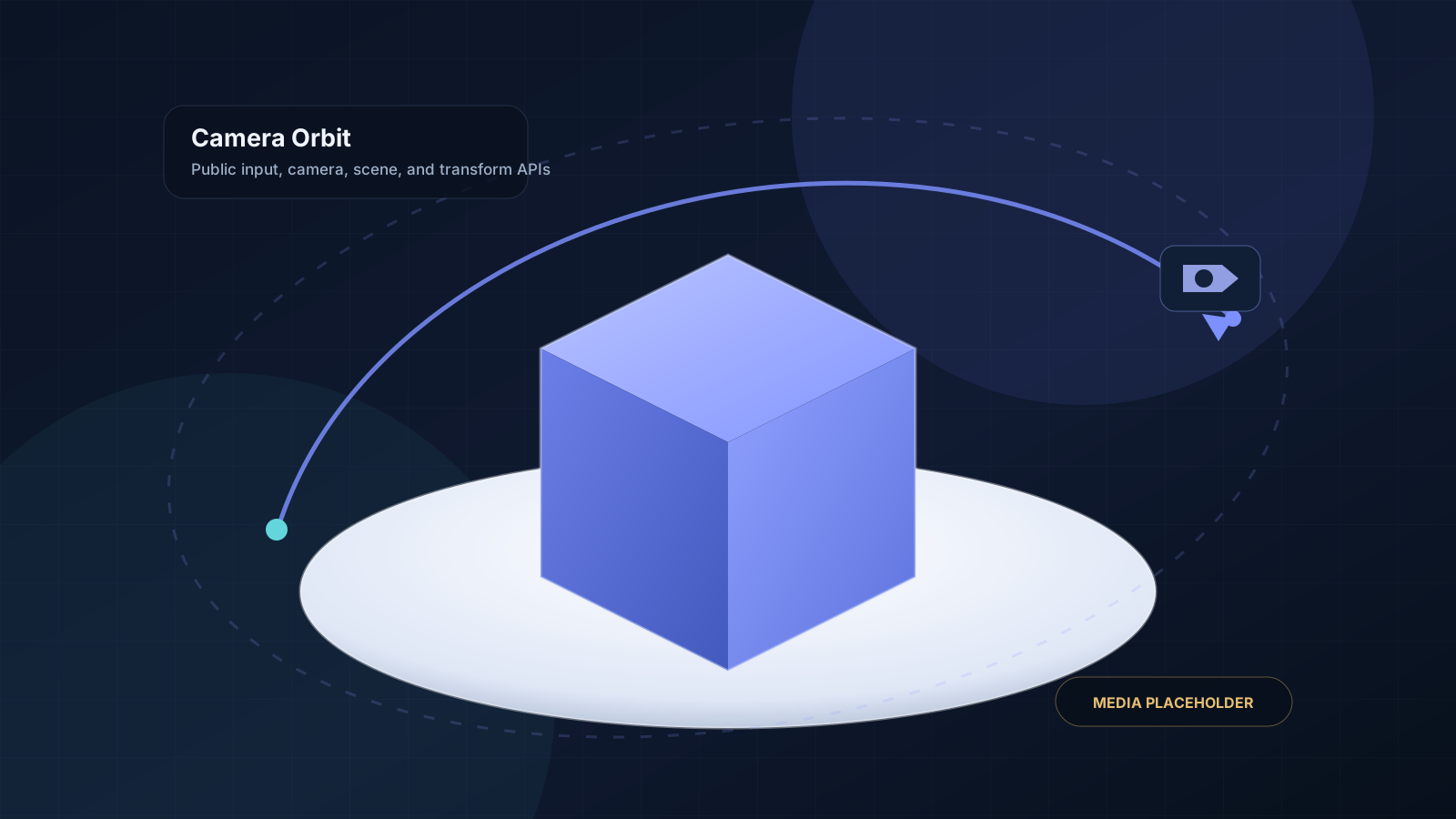
Camera Orbit
A small interactive 3D example built entirely through public Kova app, desktop, input, scene, mesh, material, light, camera, and transform APIs. Mouse input updates the camera's local transform while Kova's normal transform propagation derives the global state before extraction and rendering.
Controls
- Move the mouse to orbit around the scene
- Press
Escapeto release the cursor - Click the left mouse button to capture it again
- Vertical rotation is clamped to prevent inversion
What it proves
- Public
KovaAppconstruction and desktop plugin composition - Ordinary
StartupandUpdatesystems - Keyboard, mouse button, and mouse motion resources
- Public camera, transform, material, mesh, and light authoring
- Cursor capture through a public window-facing contract
- No direct WGPU, winit, or manual renderer lifecycle usage
Application and system composition
use kova_desktop::prelude::*;

let mut app = KovaApp::new();
app.add_plugins(
    KovaDesktopPlugins::new()
        .with_window_title(WindowTitle::new("Kova Camera Orbit"))
        .with_window_size(WindowSize::new(960, 540)),
)?;

app.world_mut()
    .insert_resource(CameraOrbitSettings::default());
app.world_mut()
    .insert_resource(CameraOrbitState::from_settings(
        CameraOrbitSettings::default(),
    ));

app.add_systems(Startup, setup_camera_orbit_scene);
app.add_systems(Update, update_camera_orbit);
app.run()?;
Representative excerpt from the current private example. Error handling and cursor-state setup are shortened here for readability.
Public scene, mesh, material, and light authoring
let mut scene = SceneList::new();

let cube_mesh = scene.asset(asset_value(
    MeshAsset::position_normal_from_cuboid(
        MeshId::new("example.mesh.cube"),
        MeshLabel::new("Cube"),
        Cuboid::new(1.0, 1.0, 1.0),
    )?,
));

let cube_material = scene.asset(asset_value(
    MaterialDescriptor::standard(
        MaterialId::new("example.material.cube"),
        MaterialLabel::new("Blue cube"),
        StandardMaterial::lit(Color::srgb_rgb(
            124.0 / 255.0,
            144.0 / 255.0,
            1.0,
        ))
        .with_roughness(0.55),
    ),
));

scene.spawn((
    PointLight3d::new(LightColor::WHITE, 1_000_000.0, 20.0)
        .with_radius(0.25),
    Transform3d::from_xyz(4.0, 8.0, 4.0),
    GlobalTransform3d::IDENTITY,
));

scene.mesh_draw_3d_local_at(
    cube_mesh,
    cube_material,
    Transform3d::from_xyz(0.0, 0.51, 0.0),
);
scene.apply(world)?;
The public example creates its scene without obtaining GPU buffers, render passes, swapchain objects, or backend resource handles.
Camera transform from public input state
fn camera_transform(
    yaw: AngleRadians,
    pitch: AngleRadians,
    target: Vec3,
    distance: f32,
) -> Transform3d {
    let orientation = Transform3d::from_euler(
        EulerRot::YXZ,
        yaw,
        pitch,
        AngleRadians::ZERO,
    );

    let position = target - orientation.forward() * distance;

    Transform3d::from_translation(position)
        .looking_at(target, Vec3::Y)
}
The full example validates finite input, wraps yaw, clamps pitch, handles cursor capture, and updates exactly one marked camera.
Static vertical path
Basic 3D
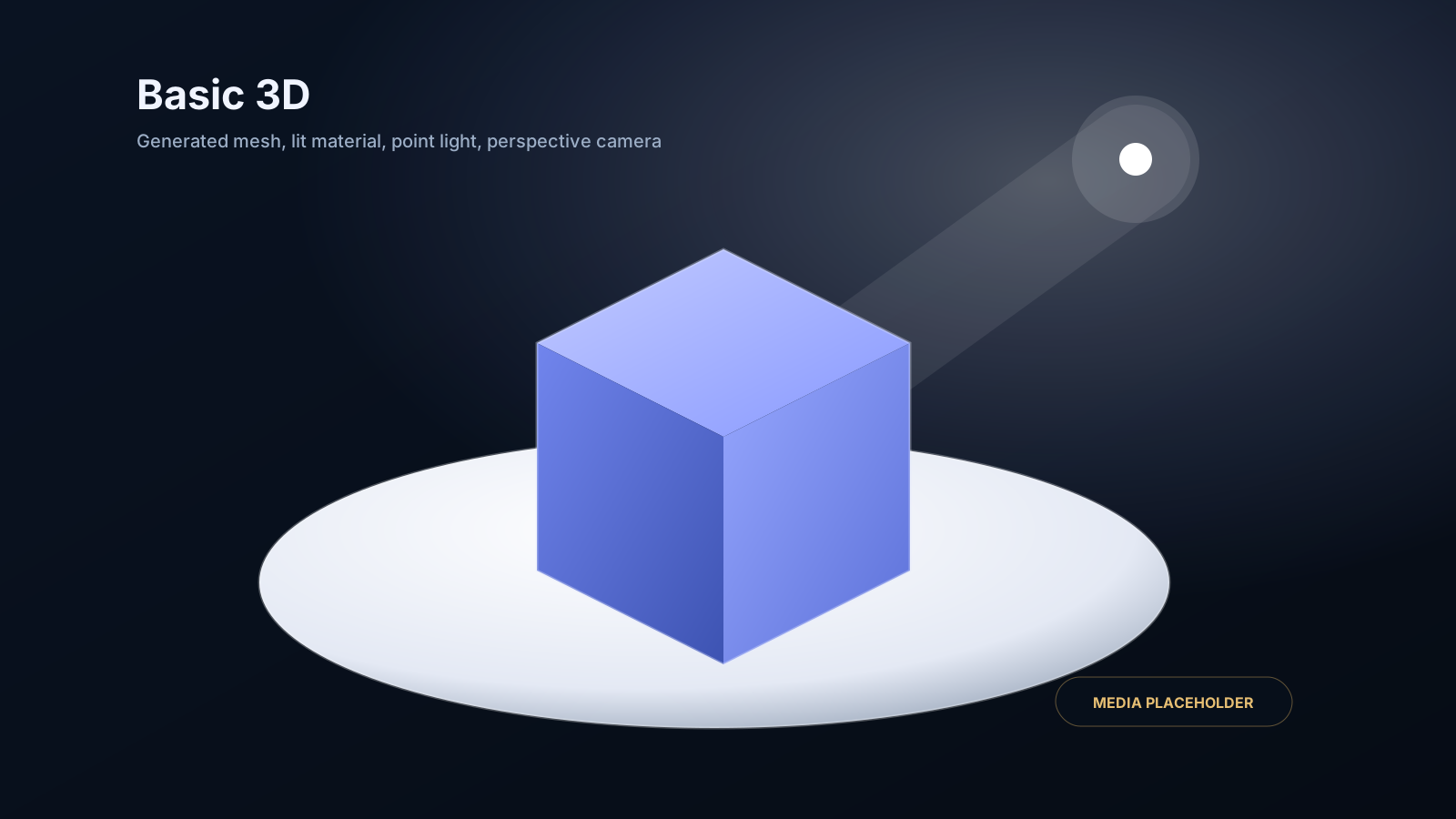
The Basic 3D example is a minimal static desktop scene authored through the same public APIs intended for external engine users.
It creates generated meshes, lit standard materials, ambient lighting, a photometric point light, a perspective camera, and local transforms before running through Kova's public desktop path.
let mut app = KovaApp::new();
app.add_plugins(
    KovaDesktopPlugins::new()
        .with_window_title(WindowTitle::new("Kova Basic 3D"))
        .with_window_size(WindowSize::new(960, 540)),
)?;
app.add_systems(Startup, setup_basic_3d_scene);
app.run()?;let camera_transform =
Transform3d::from_xyz(-2.5, 4.5, 9.0)
.looking_at(Vec3::ZERO, Vec3::Y);
scene.camera_3d_local(camera, camera_transform);What it proves
- One normal public desktop runner path
- Generated meshes with position and normal data
- Public lit material descriptors and camera authoring
- Local-to-global transform propagation
- A lit forward rendering path
- No manual prepare, queue, render, or present calls
Separate authoring path
Basic 2D
The Basic 2D example validates a separate 2D authoring path rather than presenting 2D objects as dummy 3D geometry.
A translated and rotated root owns two child draws. Explicit DrawOrder2d values prove that visible ordering is independent of entity creation order.
world.spawn(KovaDesktopScene2d::default_camera())?;

let root = world.spawn((
    Transform2d::from_translation_xy(-0.65, -0.20)
        .with_rotation(AngleRadians::new(0.12)),
    GlobalTransform2d::IDENTITY,
))?;

let front = world.spawn((
    Mesh2d::new(front_mesh),
    MeshMaterial2d::new(front_material),
    DrawOrder2d::new(10),
    Transform2d::from_translation_xy(0.75, 0.15)
        .with_rotation(AngleRadians::new(-0.22)),
    GlobalTransform2d::IDENTITY,
))?;

world.insert_component(front, Parent::new(root))?;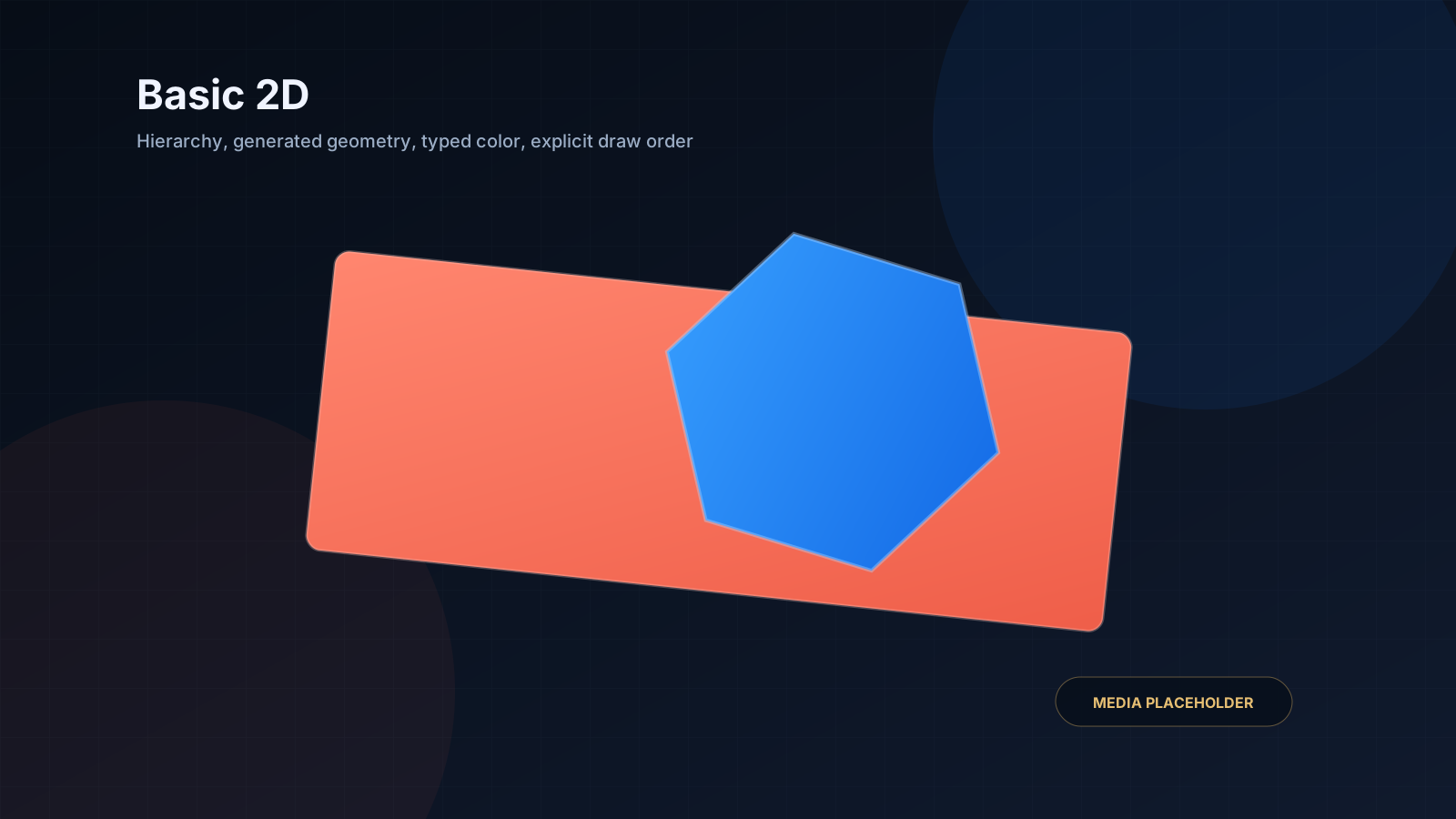
What it proves
- An orthographic public 2D camera
- Generated rectangle and regular-polygon meshes
- Typed sRGB colors and unlit material descriptors
- Explicit 2D draw ordering
- Parent-child transform propagation
- A dedicated 2D path without transform-Z ordering hacks
System boundaries
Architecture
Kova is divided by ownership and dependency boundaries rather than by arbitrary feature folders. User-facing domain APIs remain separate from WGPU, winit, and platform-specific resource ownership. Runtime and backend crates may use those dependencies, but gameplay-facing code should not need to understand them.
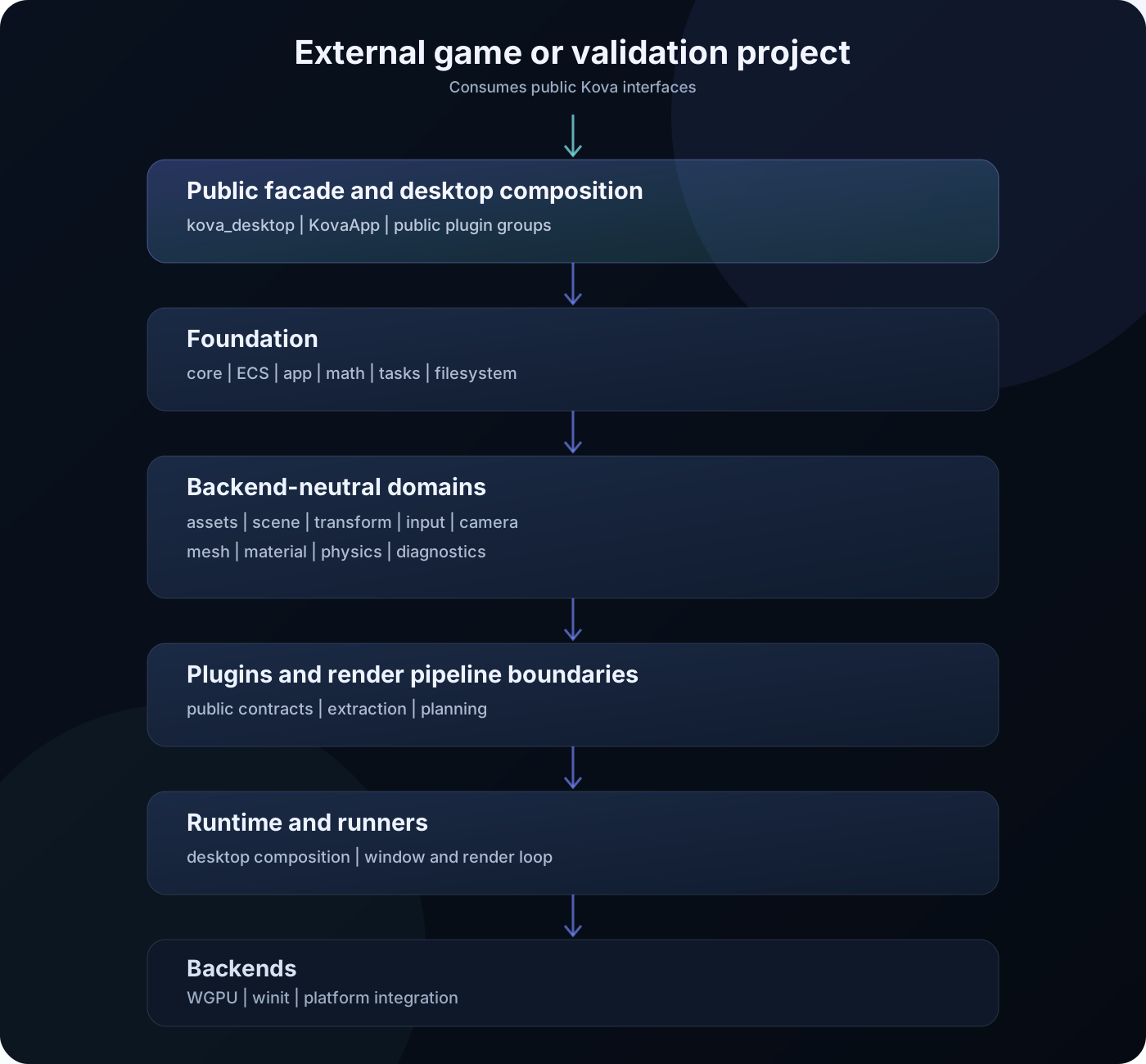
Backend-hidden gameplay APIs
Gameplay-facing and domain APIs should not expose WGPU objects, winit events, backend resource handles, or manual rendering lifecycle operations.
Public extension symmetry
First-party plugins should use the same public extension mechanisms intended for future third-party plugins. Kova should not rely on privileged internal plugin paths.
Product-neutral engine core
Kova remains independent from the Freven game, platform, content, and publishing policy. Freven acts as a downstream pressure test rather than defining the engine's public identity.
Library-first, editor-aware
The runtime should remain usable without an editor. Editor architecture is being planned early, but it is not allowed to become a hidden requirement for building or running a project.
Public surface
What engine-user code should look like
Kova's high-level examples are intentionally written to resemble external user code.
- Construct a
KovaApp - Compose public plugins
- Register startup and update systems
- Author assets and scene entities
- Respond to public input resources
- Run through a public desktop path
It should not need to allocate GPU buffers manually, own a surface or swapchain, call extraction stages, invoke prepare or present functions, process raw winit events, or import product-specific Freven types.
let mut app = KovaApp::new();

app.add_plugins(KovaDesktopPlugins::new())?;
app.add_systems(Startup, setup_scene);
app.add_systems(Update, update_gameplay);

app.run()?;
The exact public API remains pre-alpha and may change, but the architectural boundary is deliberate.
Implemented evidence
Current capability status
| Area | Current evidence | Status |
|---|---|---|
| Application and plugin composition | KovaApp, schedules, and desktop plugin groups used by runnable examples | Working foundation |
| ECS and resource model | Public world, components, resources, systems, and hierarchy paths | Working foundation |
| Desktop runner | Real WGPU and winit desktop path behind public composition APIs | Working foundation |
| 3D scene authoring | Basic 3D and Camera Orbit examples | Validated example |
| 2D scene authoring | Basic 2D example with hierarchy and draw ordering | Validated example |
| Input and camera control | Mouse, keyboard, cursor capture, and orbit camera | Validated example |
| Meshes, materials, and lighting | Generated geometry, lit and unlit materials, ambient and point light | Working vertical path |
| Transform hierarchy | Public local and global 2D and 3D propagation | Validated example |
| Asset identity and catalog work | Logical identities, production catalog, and deterministic variant resolution | Active development |
| External project use | Clean external-consumer validation path | Active validation |
| Editor | Architecture and authoring tools planned | Not yet a release claim |
| Public source release | Licensing, security, CI, docs, and release audit gate | In preparation |
Engineering method
Built through validation, not diagrams alone
Kova's architecture is pressure-tested with small external-style applications and focused validation packages. The visual examples are kept outside engine crates and consume public interfaces. When an example discovers missing reusable functionality, that gap is fixed or tracked in the owning engine layer rather than hidden inside example-specific code.
Where practical, the same authored paths are paired with backend-free or bounded smoke validation so that CI can check application, scene, and frame behavior without requiring an interactive desktop.
cargo +stable run --locked -p kova_example_camera_orbit
cargo +stable run --locked -p kova_example_basic_3d
cargo +stable run --locked -p kova_example_basic_2d
The repository is still private. These commands document the current internal examples and will become usable from a clean public checkout after the public-source release gate is completed.
Examples use intended public entry points instead of backend shortcuts.
Engine crates do not depend on example packages.
Visible windows are avoided when a smoke path can validate the same authored state.
Backend-specific types are checked at layer boundaries.
API gaps discovered by examples are recorded rather than concealed.
Clean use outside the engine workspace is treated as a release requirement.
Current engineering focus
Current work
With the M2 public API validation milestone complete, current work is split between public-source release preparation, ordinary engine ergonomics, and the production content path. Recent work focuses on explicit logical asset identity, immutable production catalogs, deterministic asset variant resolution, and reproducible external-consumer validation.
Production content architecture
Establishing stable logical asset identity, catalog ownership, and deterministic resolution before expanding the authoring and import workflow.
External consumer path
Ensuring that a project outside the engine workspace can use documented public interfaces without relying on private repository structure or internal hooks.
Public-source pre-alpha gate
Preparing licensing and provenance, security reporting, public CI, documentation, contribution workflows, distribution rules, launch examples, and a final release audit.
Roadmap and limits
Pre-alpha means explicit limitations
Current limitations
- The repository remains private
- Public APIs are unstable and may change
- Kova does not yet claim that an external developer can ship a complete game
- The editor is not production-ready and is not presented as a finished product
- Current examples prove selected vertical paths, not complete production workflows
- Some system-parameter ergonomics still require lower-level public
Worldaccess - The current Basic 3D path does not prove production shadows, HDR, automatic exposure, or tonemapping
- Packaging and distribution remain part of later readiness work
Active directions
- Production content loading and external project workflows
- Ordinary engine-user API ergonomics
- Editor pre-alpha architecture and tools
- Broader renderer and material readiness
- Audio, animation, runtime UI, and gameplay-support systems
- Networking and server-authoritative architecture
- Scripting, modding, and data-driven authoring
- Optional voxel extensions as an extensibility pressure test
- Structured interfaces for future tooling and automation
Structured, inspectable engine operations may later support external tools and coding agents, but agent-facing integration is currently a research direction rather than a released feature.
Product neutrality
Engine foundation and downstream pressure test
Kova and Freven are deliberately separated.
Kova owns the reusable engine, public APIs, runtime composition, renderer boundaries, examples, and validation infrastructure.
Freven is a downstream game and product that can pressure-test Kova through the same public interfaces intended for other projects. Game-specific content, account systems, launcher behavior, publishing, moderation, and product policy remain outside the Kova engine repository.
This separation helps prevent one game's requirements from becoming accidental engine architecture.
Related engineering work
Work around engines and difficult boundaries
Developer
Built by Danylo Yenikeiev
I am a software engineer based in Poland, working across Rust, Python, TypeScript, backend systems, networking, Linux, Docker, and developer tooling.
Kova is my long-term engine architecture project. Building it requires work across public API design, ECS and application lifecycle, rendering boundaries, scene and transform systems, assets, input, validation infrastructure, and downstream project compatibility.
Open to contract and long-term work
- Game-engine and runtime development
- Editor and developer tooling
- Engine, DCC, and SDK integrations
- Plugins and extension infrastructure
- Networking and local services
- Lifecycle and reliability work
- Automation and tool-facing interfaces
- Difficult cross-system debugging
Contact
Working on an engine, tool, or integration?
I am interested in technically demanding contract and long-term work around engines, editor tooling, plugins, SDKs, runtime infrastructure, and developer automation.
The Kova repository remains private during active development, but I can provide a focused private code walkthrough or discuss the architecture for a relevant technical opportunity.